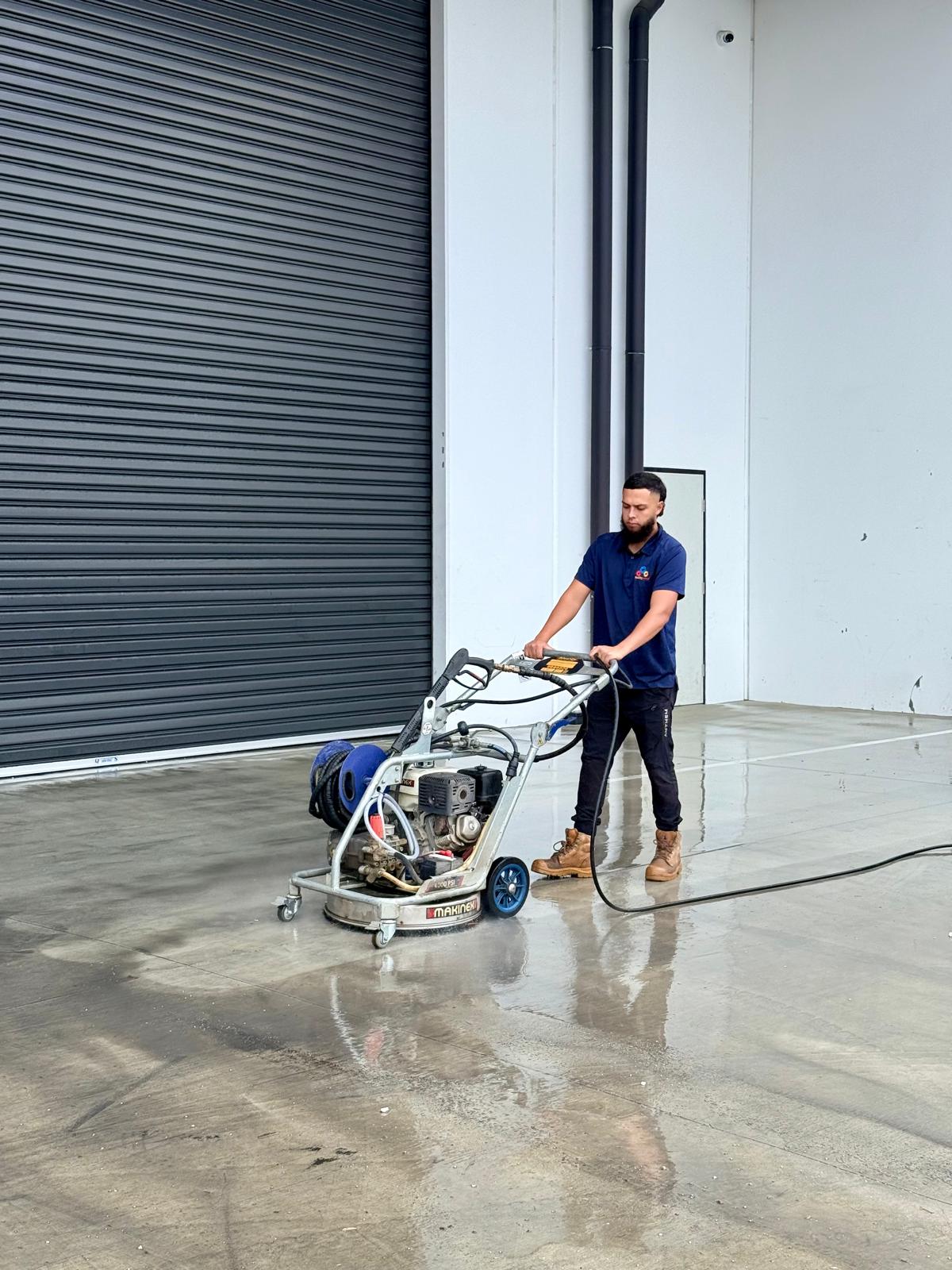
Large warehouse cleaning relies on ride-on scrubber-driers for floors, high-reach vacuum systems for racking and beam dust, scheduled works around forklift traffic, and a site-specific SWMS covering traffic management and working at heights.
- 1Warehouse cleaning is a traffic-management job as much as a cleaning job.
- 2Ride-on scrubbers cover 3,000–5,000 sqm per hour; manual mopping cannot compete.
- 3High-level dusting of racking and beams is where most dust actually lives.
- 4Work must be scoped around forklift movement with an agreed exclusion zone.
Floors: machines, not mops
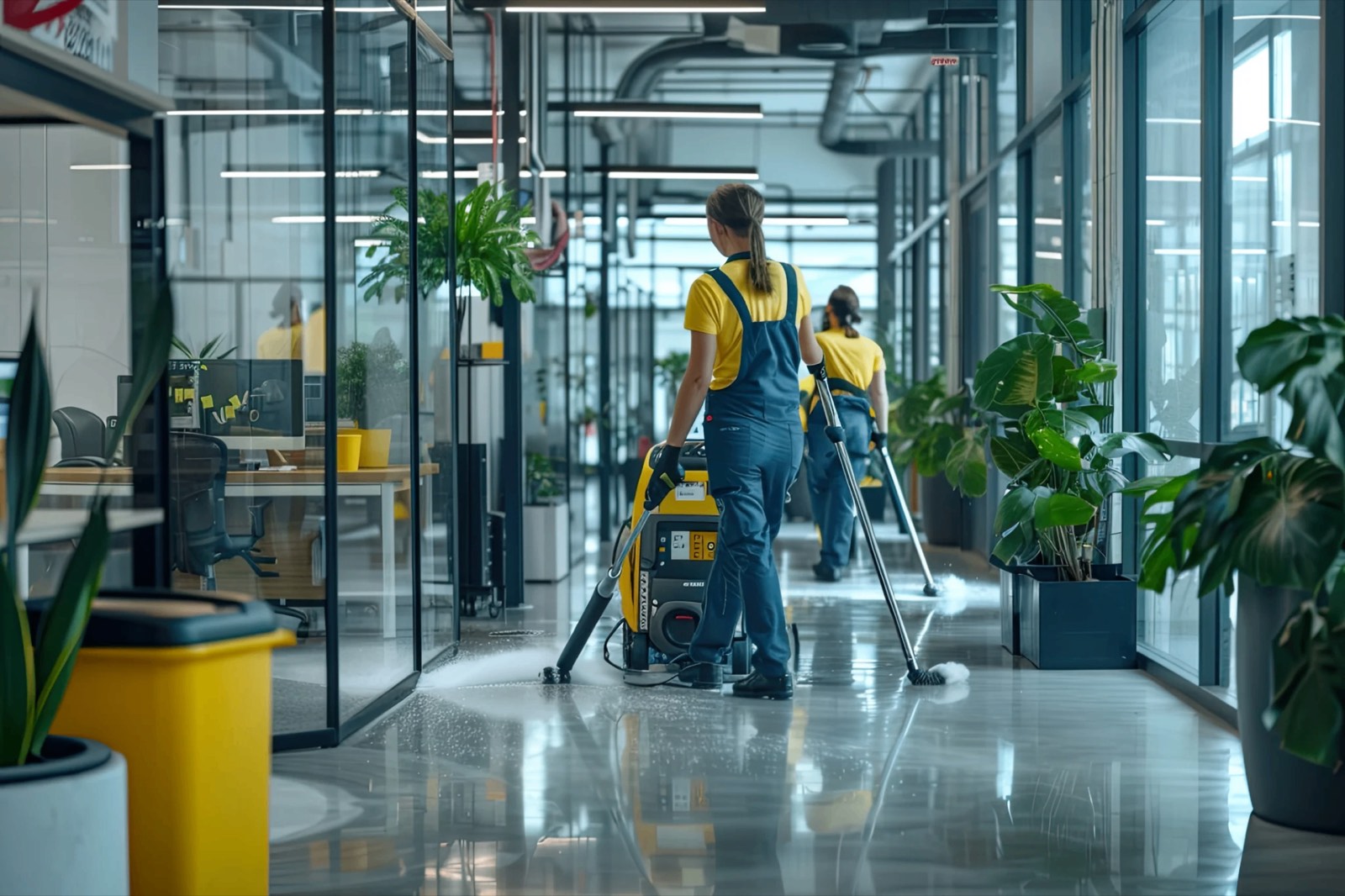
Above roughly 1,500 square metres, manual mopping is neither economic nor effective. A ride-on scrubber-drier cleans and dries in one pass, which keeps aisles usable and removes the slip hazard a wet mop creates in a forklift zone.
For Brisbane sites around Acacia Ridge, Wacol, Yatala and the Australia TradeCoast, tyre rubber build-up and pallet scuffing are the usual challenge. Periodic scrubbing with an aggressive pad plus a floor sealer restores line marking visibility and extends slab life.
| Floor area | Primary equipment | Time per clean | Crew |
|---|---|---|---|
| Under 500 sqm | Walk-behind scrubber | 1 – 2 hrs | 1 |
| 500 – 2,000 sqm | Large walk-behind + sweeper | 2 – 4 hrs | 1 – 2 |
| 2,000 – 8,000 sqm | Ride-on scrubber | 3 – 6 hrs | 2 |
| 8,000 sqm + | Ride-on + support crew | 6 – 10 hrs | 3 + |
| High-level racking | Scissor lift / EWP | Scheduled shutdown | 2 (licensed) |
The dust nobody sees
Racking beams, structural steel, sprinkler pipework and light fittings accumulate dust that eventually falls onto stock. High-level cleaning uses extendable vacuum poles or scissor lifts with a licensed operator, scheduled annually or six-monthly for food-grade sites.
This is also a fire and insurance issue. Heavy dust loading on sprinkler heads and light fittings is a common insurer finding.
- Floor traffic lanes45%
- Racking & beams25%
- Dock & roller doors20%
- Amenities & office10%
WHS documentation you should expect
A competent industrial cleaner will provide a site-specific SWMS, evidence of high-risk work licences where lifts are used, chemical SDS records, and induction completion for every attending worker.
- Traffic management plan for cleaning during operational hours
- Exclusion zoning and signage for wet or in-progress areas
- Spill response procedure for oil, chemical and product spills
- Waste segregation aligned to your site's recycling streams
Shutdown clean
Safest- Full floor and high-level access
- No forklift interaction risk
- Requires downtime
- Best for periodic deep cleans
In-operation clean
No downtime- Zoned with cones and spotters
- Suits routine floor scrubbing
- High-level work not possible
- Needs a documented traffic plan
Frequently asked questions
Can warehouse cleaning happen during operating hours?+
Yes, with a traffic management plan and zoned exclusion areas. Most Brisbane sites prefer a night or weekend window for full-floor scrubbing.
How often should a warehouse floor be scrubbed?+
High-traffic distribution floors weekly or nightly; lower-throughput storage warehouses fortnightly, with a quarterly deep scrub and reseal cycle.